

The Quality Teaching Framework
As a land grant institution, a commitment to teaching and the goal of transformative education accessible to all learners, is part of our mission. The following criteria constitute the Quality Teaching (QT) Framework, which articulates principles of teaching excellence at OSU.
The QT Framework is aligned to OSU’s mission, supported by research, and provides the OSU community with a foundation for a multifaceted evaluation of teaching which includes learner experience surveys, peer review processes, and teaching portfolios. This work is informed by an acknowledgment that the diversity of our learners and ourselves is an asset, and that our capacity to deliver excellent instruction arises from our shared commitment and rigorous creativity in supporting learners and their learning.
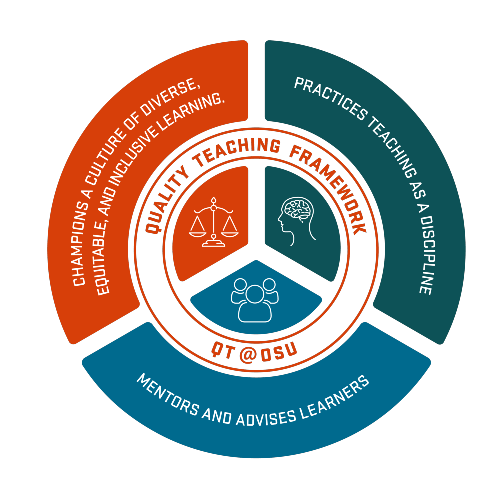
These criteria are understood to apply to all modalities (face-to-face, online, remote, and hybrid) and include three broad principles: Inclusivity, Best teaching practices, and Mentorship. The sub-principles (e.g., 1.1, 1.2) provide direction for how to achieve the broad principles. How individuals incorporate these principles and sub-principles will vary by context, discipline, position description, and more. Examples for each sub-principle are not an exhaustive list, allowing Colleges or Departments to adhere to the QT in context-specific ways.
OSU faculty are committed to quality teaching and student success. An instructional faculty member engaged in quality teaching is one who:
-
Champions a culture of Diverse, Equitable, and Inclusive Learning.
- Recognizes how their own identity influences the learning environment and intersects with broader cultural, social, and political contexts.
- Mitigates barriers and provides pathways for learners to achieve full participation.
- Builds a sense of belonging and enables collaboration across difference.
- Ensures each learner has the resources and experiences needed to achieve shared goals.
-
Practices teaching as a discipline.
- Demonstrates intentional and effective course design.
- Demonstrates evidence-based and disciplinary facilitation.
- Demonstrates intentional and effective assessment.
- Learns from and contributes to the professional development of teaching.
- Maintains currency in disciplinary practices and content.
-
Mentors and advises learners.
- Supports learners in their personal growth.
- Supports learners in their professional growth.
- Supports learners in their academic growth.
For an overview of the historical evolution of the QT Framework and SLEs, here is a recording of Devon Quick's CTL talk on the QT Framework. View this VIDEO for additional information on using these OSU adoptions to evaluate effective teaching.
Examples of ways OSU faculty support each Sub-Principle
1. Champion a culture of Diverse, Equitable, and Inclusive Learning
- 1.1 Recognizes how their own identity influences the learning environment and intersects with broader cultural, social, and political contexts.
- Understanding oneself and others as socialized and cultural beings, including the examination of attitudes, beliefs, assumptions, and biases.
- Exploring one’s own positionality, especially in relation to historical and contemporary experiences of power, privilege, and oppression for different communities of people.
- Modeling and promoting inclusivity by recognizing, validating, and attending to the full diversity of backgrounds, ages, cultures, thinking, proficiencies, and experiences, including educational models.
- Maintaining curiosity about one’s learners, including their names, strengths, experiences, and learning goals.
- Recognizing the power differential in learning environments, and acting with integrity and empathy.
1.2 Mitigates barriers and provides pathways for learners to achieve full participation.
- Maintaining systemic and macro perspectives, and examining disparities associated with social and cultural capital.
- Providing materials in formats that are accessible by all learners, including curricular materials designed with recommended fonts and colors.
- Consulting with experts to improve access to course materials, including DAS, Ecampus, CTL, and Valley Library Course Reserves.
- Encouraging learners to take advantage of campus support and resources, including Workshops, Writing Centers, HSRC food pantry, and emotional and mental health resources (CAPS).
1.3 Builds a sense of belonging and enables collaboration across difference.
- Creating a safe learning environment that protects students from social and structural inequities stemming from stigmatization, including racism, sexism, and ageism.
- Modeling accountability for shared mission, vision, and values by naming and confronting biases, as well as explicitly discussing expectations and mechanisms for conflict resolution.
- Recognizing and honoring that learners may share knowledge in ways that appear to conflict with traditional models of demonstrating and communicating knowledge.
- Fostering community outside of the classroom.
- Using inclusive and affirming language, and exercising generosity and curiosity before judgment.
- Providing materials, cases, or assignments that examine diverse experiences, perspectives, or populations.
1.4 Ensures each learner has the resources and experiences needed to achieve shared goals.
- Attending to the dynamic needs, strengths, and abilities of diverse learners by preparing and including a variety of assignments and assessments.
- Applying principles of Universal Design for Learning.
- Facilitating dialogue with learners to discern learning goals and priorities for the group.
- Giving learners choices for communicating knowledge in a variety of ways with equitable rigor, such as through written essays, qualitative inquiry, and creative reflection.
- Using active learning strategies that enable learners to apply their learning to real-world problems and practice professional skills, such as through case studies and group work.
- Fostering learner reflection on present work and its connections to learners’ lives and future careers.
- Incorporating service learning projects (e.g., a project that restores local historical ruins as a course based project).
2. Practices teaching as a discipline.
2.1. Demonstrates intentional and effective course design.
- Using evidence-based design principles (e.g., Backwards Design, accessibility, UDL principles).
- Using measurable course learning outcomes.
- Aligning learning outcomes with learning activities and assessments.
- Stating and implementing clear course policies and expectations.
- Using relevant and current curricular materials and resources.
2.2 Demonstrates evidence-based and disciplinary facilitation.
- Working with students to create a safe learning environment (e.g., co-creating expectations for civility, fostering community, providing encouragement and support).
- Planning effective content delivery (e.g., well-organized, chunked content, appropriately paced with wait time).
- Incorporating effective instructional methods and strategies (e.g., active lectures, interdependence and group work, metacognition, contemplative teaching, sequenced questioning, use of visuals, discussions, critical thinking).
- Planning and enacting effective interactions (e.g., learner-to-learner, learner-to-instructor, and learner-to-content).
- Implementing opportunities to motivate students (e.g., developing appreciation for the discipline, cultivating growth mindsets).
- Teaching students how to learn within the discipline (e.g., taking notes, reading, writing, retrieval and spacing practices).
- Encouraging real-world connections among and between the classroom, learners’ lives, and future careers.
2.3 Demonstrates intentional and effective assessment.
- Setting and communicating clear grading policies (e.g. late work, extra credit, grading practices)
- Using formative and summative approaches to monitor progress (e.g. pre/post assessments, un-graded, Muddiest Point)
- Using a variety of assessments that reaches learners’ varied strengths, abilities, readiness, and interests.
- Providing clear and concise directions and sharing examples .
- Embedding academic support in tasks (e.g., creating study groups, requiring consultations with writing studio, librarians, or learning support centers).
- Measuring, documenting, and using achievement data to inform instruction
- Providing meaningful, targeted, and timely feedback (e.g., progress reviews, rubrics aligned to assessments, annotations, video).
- Incorporating opportunities for revisions and learner reflection on growth (e.g., reflective essays, process memos, posttest reflections).
2.4 Learns from and contributes to professional development of teaching.
- Participating in department-level, institutional, discipline-based, interdisciplinary, or modality driven teaching communities
- Maintaining currency in discipline/content area teaching and general evidence-based teaching in higher-ed (e.g. standards, methods)
- Consulting and/or mentoring with other teaching practitioners and experts
- Seeking and/or contributing to teaching resources and support (e.g. current literature, workshops, SoTL, scholarly conferences, seminars)
- Using varied approaches to examine and inform one’s teaching (e.g. regular self-reflective activities, peer reviews, collegial observations, consultations with faculty development specialists, video reflections, mid- and end-of term student feedback).
2.5 Maintains currency in disciplinary practices and content.
- Reviewing current disciplinary standards or methods
- Reading, discussing current literature
- Attending scholarly conferences, workshops, seminars
- Performing research in these areas
3. Mentors and advises learners.
3.1 Supports learners in their personal growth.
- Fostering trust, mutual understanding, and connection
- Listening mindfully and without judgement (e.g., words, tone, attitudes, and body language)
- Providing care (e.g., providing moral, emotional, and social support related to being in college)
- Expressing encouragement and contributing to learners’ sense of place
- Providing support during “transition” periods (e.g., undergraduate to graduate, graduate to professional)
- Helping learners identify their unique competencies and challenges to define short and long-term social goals
- Encouraging use of available resources (e.g., HSRC food pantry, mental health resources).
3.2 Supports learners in their professional growth.
- Examining degree options in relation to different careers
- Helping learners identify their unique competencies and challenges to define short and long-term research and career goals
- Connecting learners to resources, professionals, and opportunities to advance their professional skills (e.g., grant writing, networking publishing, presenting scholarship, leading projects)
- Writing letters of reference, recommendation
3.3. Supports learners in their academic growth.
- Helping learners identify their unique competencies and challenges to define short and long-term coursework and academic goals.
- Teaching learners how to take ownership of their own learning process (e.g., developing work plans, reflecting on learning outcomes from lectures or exams).
- Providing guidance on finding, interpreting, and applying scholarly works.
- Guiding learners in developing research projects with achievable outcomes.
- Supporting learners’ scholarship skills (e.g., research, writing, and verbal communication skills).
- Motivating learners to engage and persist in their studies to the best of their abilities.
- Serving as a model by sharing challenges that were overcome to accomplish academic goals.
- Providing ongoing support to assist learners in improving their performance and achieving their academic aspirations.
- Meeting regularly to communicate progress and provide purposeful feedback with undergraduate, graduate, and research learners.
- Referring learners to the appropriate technology, academic, or learner support services in response to articulated or observed needs